Outdoor Security Camera Design: IP66, IP67, IK10 & Housing Guide
Outdoor security camera durability comes down to two standards: IP for water and dust, IK for impact. How IP66 vs IP67 and IK10 play out on site.
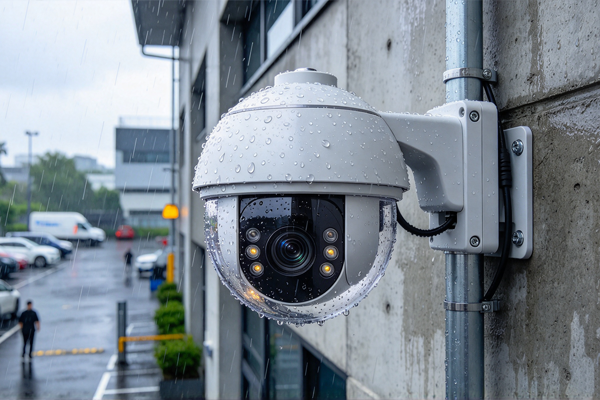
[Core Answer] Outdoor security camera durability is defined by two ratings: IP (Ingress Protection, IEC 60529) for moisture and dust resistance, and IK (IEC 62262) for impact resistance. IP66 is the practical minimum for exposed outdoor installations; IK10 is the target for public-facing vandal-resistant deployments. Both ratings reflect factory test conditions -- real-world performance depends equally on correct cable entry sealing and installation technique.
TL;DR - 6 Key Technical Facts
IP ratings are defined by IEC 60529, first published in 1976. The two-digit code rates solid particle protection (0-6) and liquid ingress protection (0-9). The standard provides precise test criteria replacing vague marketing terms like 'waterproof' (IEC, iec.ch).
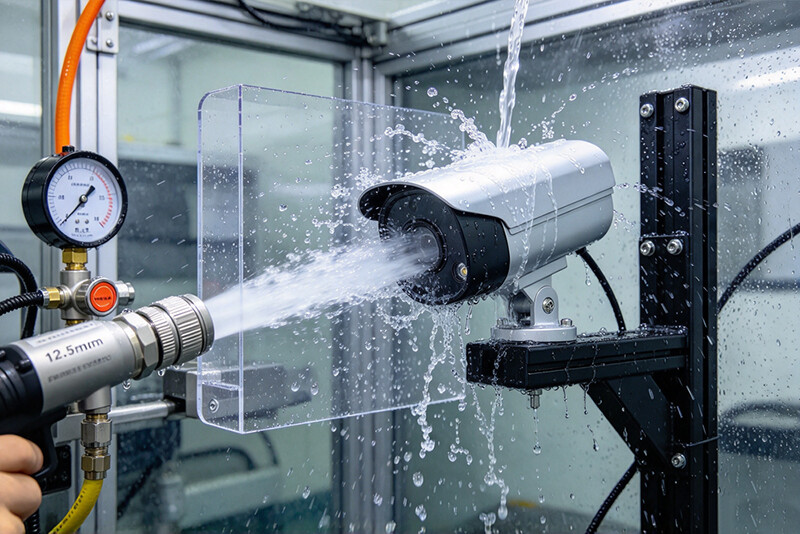
IP66 is the practical minimum for exposed outdoor installations: it survives powerful water jets at 100 L/min and 100 kPa from any direction, with complete dust exclusion.
[Critical] IPX7 (1m immersion, 30 minutes) and IPX8 (deeper immersion) ratings are NOT cumulative with IPX5/IPX6 water jet ratings. A camera rated IPX7 has not necessarily passed jet-water tests. Both must be tested separately and listed (e.g., IP67/IP66) per IEC 60529.
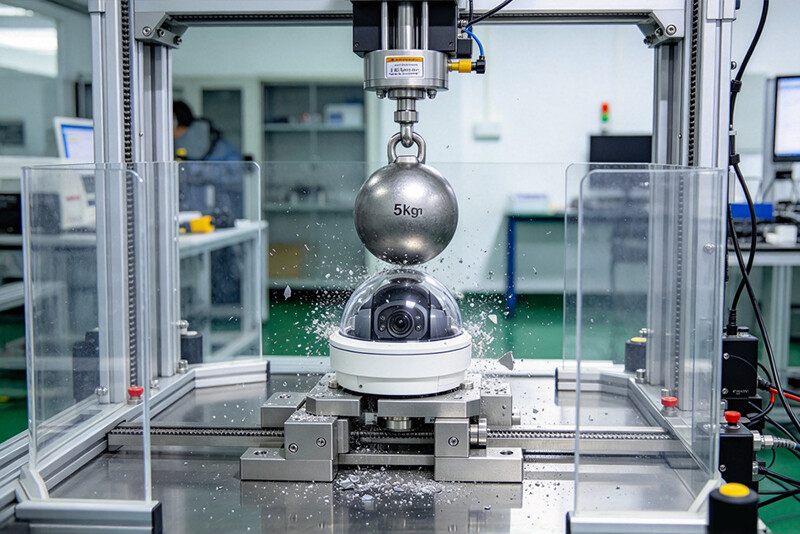
IK10, defined by EN 62262 (IEC 62262), is the highest standard impact resistance rating: 20 joules (5 kg from 400mm). This is the target for cameras in public spaces, transportation hubs, urban environments, and any installation accessible to unauthorized persons.
Cable entry sealing is the most common real-world failure point for high-IP-rated cameras. The factory IP test is performed with blanked-off cable entries; installed cameras must have glands sized and sealed to the specific cable diameter.
NEMA 4/4X corresponds approximately to IP65/IP66; NEMA 6 to IP67; NEMA 6P to IP68 (NEMA Standard 250; IEC 60529). These equivalences are approximate -- NEMA ratings include additional tests not in IEC 60529.
What IP Ratings Actually Mean
The IP code - defined under IEC 60529, published by the International Electrotechnical Commission -classifies how well an enclosure resists ingress of solid particles and liquids. Per the IEC's official description, the standard provides users with more meaningful technical information than vague marketing terms such as 'waterproof' or 'water-resistant' (iec.ch).
First Digit: Solid Particle Protection (0-6)
Level | Protection Against | In Practice |
|---|---|---|
0 | None | No protection |
1 | Objects >50mm | Protection against large body contact only |
2 | Objects >12.5mm | Protection against fingers |
3 | Objects >2.5mm | Protection against tools and thick wires |
4 | Objects >1mm | Protection against most wires and fine tools |
5 | Dust-protected | Dust may enter but not in quantities affecting safe operation |
Source: IEC 60529 (Degrees of Protection Provided by Enclosures), International Electrotechnical Commission (iec.ch).
[For Outdoor Cameras] A first digit of 6 (dust-tight) is the correct specification for any outdoor camera. Dust ingress around the lens or into electronics causes image degradation and accelerates component failure.
Second Digit: Liquid Ingress Protection (0-9)
The liquid ingress digits represent distinct tests, not a linear progression. An important technical point in IEC 60529: ratings beyond IPX6 are NOT cumulative with jet-water ratings. A camera rated IPX7 has passed the immersion test but has not necessarily passed IPX5 or IPX6 water jet tests. For cameras needing both jet resistance and immersion protection, both tests must be passed and listed separately (e.g., IPX5/IPX7 or IP67/IP66).
Level | Protection Against | Test Conditions |
|---|---|---|
0 | None | No protection |
1 | Dripping water (vertical) | 1mm/min rainfall for 10 minutes |
2 | Dripping water at 15 deg tilt | 3mm/min, 4 tilt positions (10 min total) |
3 | Spraying water up to 60 deg | 10 L/min at 50-150 kPa, 5 minutes |
4 | Splashing from any direction | Oscillating or spray nozzle, 10 minutes |
5 | Water jets (6.3mm nozzle) | 12.5 L/min at 30 kPa, 3m distance, 3 min min |
6 | Powerful water jets (12.5mm) | 100 L/min at 100 kPa, 3m distance, 3 min min |
7 | Immersion up to 1m depth | 1m submersion for 30 minutes |
8 | Immersion beyond 1m | Manufacturer-specified depth, typically up to 3m |
9 | High-pressure hot water jets | 80 deg C at 8-10 MPa, 14-16 L/min, 10-15cm distance |
Source: IEC 60529 (Degrees of Protection Provided by Enclosures), International Electrotechnical Commission. All test parameters are per IEC 60529.
IP Rating Selection for Outdoor Security Cameras
IP65: Minimum for sheltered outdoor positions (under roof overhang, covered mounting). Survives water jets from any direction using 6.3mm nozzle at 12.5 L/min.
IP66: Practical standard for exposed outdoor installations -- building exteriors, perimeter fence lines, parking structures. Survives powerful water jets (100 L/min, 100 kPa) with complete dust exclusion. Covers the vast majority of real-world outdoor environments.
IP67: For flood-prone areas, ground-level installations, or locations subject to high-pressure hose washing. Survives 1-meter immersion for 30 minutes.
IP68: For cameras in or adjacent to water features, drainage channels, or below-grade positions where prolonged submersion is possible. Test depth and duration defined by manufacturer.
IP69 (IP69K): For food processing, industrial wash-down, or car wash environments -- high-pressure (8-10 MPa) hot water (80 deg C) cleaning at close range.
What IK Ratings Mean: Impact and Vandal Resistance
IK ratings - defined by EN 62262 (IEC 62262) -- classify an enclosure's resistance to mechanical impact. For outdoor cameras in public spaces, transportation hubs, parking areas, and any installation accessible to unauthorized persons, the IK rating determines whether the camera can survive intentional physical attack.
IK Level | Impact Energy | Equivalent Test |
|---|---|---|
IK00 | Not specified | No test defined |
IK01 | 0.14 J | 200g from 70mm |
IK02 | 0.20 J | 200g from 100mm |
IK03 | 0.35 J | 200g from 175mm |
IK04 | 0.50 J | 200g from 250mm |
IK05 | 0.70 J | 200g from 350mm |
IK06 | 1.00 J | 500g from 200mm |
IK07 | 2.00 J | 500g from 400mm |
IK08 | 5.00 J | 1.7 kg from 300mm |
IK09 | 10.00 J | 5 kg from 200mm |
IK10 | 20.00 J | 5 kg from 400mm (highest standard rating) |
Source: IEC 62262 / EN 62262 (Degrees of Protection Provided by Enclosures for Equipment Against External Mechanical Impacts).
[For High-Vandalism Environments] IK10 (20 joules, 5 kg from 400mm) is the appropriate target for cameras in public spaces, urban street mounting, transit infrastructure, and retail exteriors where physical attack is a realistic risk. IK08 (5 joules) survives accidental impact but is not designed to resist determined attack.
Housing Design and Materials
Aluminum housing: The dominant material across the outdoor security camera performance range. Aluminum provides high thermal conductivity (important for heat dissipation from imaging sensors), good corrosion resistance in most environments, structural rigidity for maintaining IP sealing geometry, and sufficient hardness for IK10 ratings in appropriately designed enclosures. Die-cast aluminum is used in the majority of dome cameras, bullet cameras, and PTZ enclosures carrying IP66 or higher ratings.
[Coastal Environments] In coastal or marine environments, untreated aluminum can experience galvanic corrosion at contact points with dissimilar metals (stainless steel mounting screws). Aluminum housings for coastal installations require surface treatment - anodizing, powder coating, or marine-grade coating - to isolate the base metal from salt exposure.
Polycarbonate (PC) housing: Used in compact outdoor cameras and dome bubble covers. Provides good UV resistance when stabilized, optical clarity for dome applications, and weight reduction. Well-engineered polycarbonate housings achieve IP66 and moderate IK ratings, but achieving IK10 typically requires geometries bulkier than aluminum alternatives. For vandal-resistant dome cameras, the typical design uses a polycarbonate dome bubble within an aluminum outer housing.
Stainless steel (316L) housing: For chemical environments -- food processing, petrochemical sites, coastal marine installations. Heavier and more expensive than aluminum, but offers corrosion resistance across a wider chemical exposure range.
Camera Form Factors and Outdoor Suitability
Bullet Cameras
The cylindrical housing with integrated sun shield is optimized for fixed-direction outdoor surveillance at range. The elongated housing provides space for larger optical assemblies (longer focal length lenses, extended IR arrays) and typically makes IP67+ ratings straightforward through a single sealed housing cavity. The sun shield reduces glare from direct sunlight and provides partial lens protection from rain.
[Vandal Resistance Note] The protruding mounting arm of bullet cameras is a mechanical weak point under lateral impact. For vandal-resistant bullet camera installations, mount to a sufficiently rigid surface and review the arm-to-housing junction for the specific IK rating achieved.
Dome Cameras
The flush or semi-flush installation profile provides inherently better vandal resistance than bullet cameras - less mechanical leverage is available to an attacker, and the dome bubble geometry distributes impact force across a curved surface. Vandal-resistant dome cameras (sometimes designated 'turret' or 'vandal dome') add an aluminum outer housing to achieve IK10. These are the standard specification for public space installations - retail exterior, transportation hubs, urban street furniture.
PTZ Cameras
Outdoor PTZ cameras carry an additional engineering challenge: IP sealing must accommodate moving parts. Rotation and tilt joints are sealed through labyrinth seals, rotary lip seals, and pressurized housing designs. Most outdoor PTZ cameras carry IP66, with some high-end units achieving IP67. The moving mechanism complexity typically limits the achievable IK rating compared to fixed dome cameras.
Cable Entry and Field Sealing: The Most Common IP Failure Point
A camera housing achieving IP67 in factory testing can fail to IP20 performance on site if the cable entry is not correctly sealed. This is the most common real-world failure mode for outdoor cameras with high IP ratings. The factory IP test is performed with blanked-off cable entries - the installed camera has cables passing through those entries and must be correctly sealed.
Field Sealing Best Practices
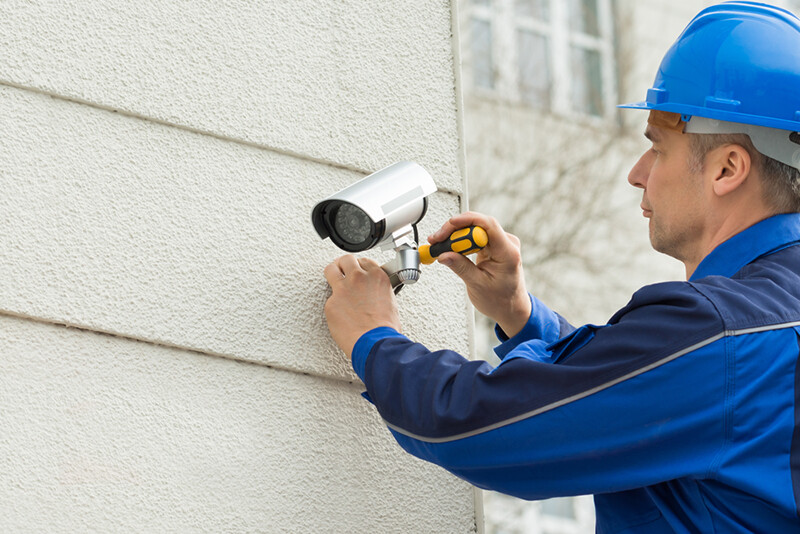
Use cable glands matching the manufacturer's recommended diameter range for the specific cable diameter being used
Apply silicone sealant to cable entries in addition to the mechanical gland, particularly for IP67 and IP68 installations
For conduit connections, use IP-rated conduit fittings -- standard fittings without IP-rated seals provide no liquid ingress protection regardless of camera rating
After installation, perform visual inspection confirming all cable entries are sealed before finalizing
Thermal Management and Operating Temperature
Outdoor cameras experience ambient temperature ranges that indoor cameras never encounter. A camera in a desert climate may see 55 deg C+ in summer and near-freezing in winter. Condensation cycling - cold nights to warm days - creates internal pressure changes that stress housing seals over time.
Operating temperature range is a specification separate from the IP rating and must be confirmed against the installation environment. Standard outdoor cameras typically cover -30 deg C to +60 deg C. Industrial-grade cameras extend to -40 deg C to +70 deg C.
Aluminum thermal conductivity (approximately 205 W/m.K) makes it effective for passive heat transfer from imaging sensors and IR LED arrays to ambient air - a key reason aluminum dominates outdoor camera housing design.
Built-in heaters in cameras rated for sub-zero operation activate when internal temperature falls below a threshold. These add to PoE power consumption and must be factored into PoE switch budget calculations.
Specification Selection: Environment Matrix
Installation Environment | IP Rating | IK Rating | Housing |
|---|---|---|---|
Sheltered exterior (under eave, covered car park) | IP65 min | IK08 if public access | Aluminum or PC |
Standard outdoor exposed (building exterior, fence) | IP66 | IK08-IK10 | Aluminum |
High-vandalism risk (urban street, transit hub) | IP66 | IK10 | Aluminum vandal dome |
Coastal / marine environment | IP66 | IK10 | Anodized/coated Al or 316 SS |
Flood-prone / ground level with standing water | IP67 | IK08-IK10 | Aluminum |
Industrial wash-down environment | IP67/IP68 | IK10 | Aluminum or 316 SS |
Below-grade or permanent water exposure | IP68 | IK10 | Manufacturer-specified |
High-pressure, high-temperature cleaning | IP69 (IP69K) | IK10 | 316 stainless steel |
FAQ
What does IP66 mean for an outdoor security camera?
IP66 is a classification under IEC 60529 indicating the camera housing is completely dust-tight (first digit 6) and withstands powerful water jets from any direction (second digit 6). The test uses a 12.5mm nozzle delivering 100 liters per minute at 100 kPa pressure from 3 meters distance. IP66 is the practical standard specification for outdoor cameras in exposed positions - building exteriors, perimeter fence lines, parking areas - exposed to rain and weather throughout their operational life.
What is the difference between IP66 and IP67?
Both include complete dust protection (first digit 6). IP66 tests resistance to powerful water jets (100 L/min at 100 kPa); IP67 tests immersion at 1 meter depth for 30 minutes. These ratings are not cumulative - a camera rated IP67 has not necessarily passed the IP66 water jet test. For installations requiring both jet resistance and immersion protection, the camera must be tested for both, listed as IP67/IP66. This distinction is explicitly defined in IEC 60529.
What is IK10 and why does it matter for outdoor cameras?
IK10 is the highest level of the IK impact resistance scale under EN 62262 (IEC 62262). An IK10-rated enclosure withstands 20 joules of impact, equivalent to a 5 kg mass dropped from 400mm through a hemispherical striker. For outdoor cameras in public spaces, urban environments, and transit infrastructure where deliberate physical attack is a realistic risk, IK10 is the appropriate specification. IK08 (5 joules) survives accidental contact but is not designed to resist determined attack.
Does IP67 mean the camera is fully waterproof?
IP67 indicates the camera has been tested for 1-meter fresh water immersion for 30 minutes. It does not cover permanent submersion (IP68), high-pressure water jet exposure (IP65/IP66), or salt water or chemical exposure (IP testing uses fresh water; other liquids are not covered per IEC 60529). Real-world waterproofing also depends on cable entry sealing quality and installation technique, regardless of the factory IP rating.
What causes outdoor security cameras to fail despite high IP ratings?
The most common cause is improper cable entry sealing during installation. The factory IP test uses blanked-off cable entries; installed cameras have cables through those entries that must be correctly sealed with appropriately sized glands and supplementary sealant. Other causes include: physical damage to housing seals during installation (overtightening mounting screws distorting housing geometry); UV degradation of polycarbonate components over multi-year outdoor exposure; and condensation cycling degrading O-ring and gasket seals over time.
What is the NEMA equivalent of IP66?
NEMA (National Electrical Manufacturers Association) ratings have approximate IP equivalents, though not directly interchangeable -- NEMA ratings include additional tests (icing conditions, hazardous area compliance) not in IP ratings. Per NEMA Standard 250: NEMA 4 and 4X correspond approximately to IP44/IP65/IP66; NEMA 6 to IP67; NEMA 6P to IP68. For North American project specifications, NEMA 4X is the common reference for outdoor applications requiring corrosion resistance alongside weather protection.
How do I choose between a bullet camera and a dome camera for vandal-resistant outdoor installation?
For IK10 vandal resistance requirements, a vandal-resistant dome camera (vandal dome or turret dome) is typically the better choice. The lower installation profile provides less mechanical leverage for an attacker, and the curved housing geometry distributes impact force more effectively than a bullet camera's cylindrical body on a projecting arm. Bullet cameras are preferred where extended focal length options or IR range are more important than maximum vandal resistance - typically perimeter surveillance at extended range where the camera is mounted above easy reach.
References
IEC 60529 -- Degrees of Protection Provided by Enclosures (IP Code), International Electrotechnical Commission: webstore.iec.ch/publication/2452
IEC 62262 -- Degrees of Protection Provided by Enclosures for Equipment Against External Mechanical Impacts (IK Code): webstore.iec.ch/publication/6671
IEC -- IP Ratings Overview, International Electrotechnical Commission: iec.ch/ip-ratings
NEMA 250 -- Enclosures for Electrical Equipment (1000 Volts Maximum), National Electrical Manufacturers Association: nema.org