China Security Camera Export 2026: Middle East Demand Surges 180%
China security camera export 2026: Middle East imports up 180%. Market data, SASO certification, and a sourcing guide for distributors.
Key Takeaways
The Middle East security camera market is expanding at a 14.7% CAGR, with China security camera export 2026 volumes to the region projected to surpass 140 million units in new installations.
China accounts for over 55% of global security camera production, making any serious procurement strategy inseparable from a trusted IP camera manufacturer China.
The global surveillance market is on track to grow from $12.8 billion (2024) to $80.94 billion by 2035, driven by AI-powered edge analytics and smart-city rollouts.
Middle Eastern buyers increasingly demand SASO-compliant hardware with IP67+ rating and Arabic-language firmware — capabilities only a handful of China CCTV export statistics leaders can deliver.
For a reliable security camera supplier Middle East distributors can count on, Phyvision offers CE/FCC/RoHS-certified OEM solutions with MOQ starting at 100 units and lead times of 7–30 days.
The Middle East security camera market is expanding at a 14.7% compound annual growth rate, with new installations projected to exceed 140 million units in 2026 — the single fastest-growing regional market in the past five years. For global buyers, this means one thing: sourcing the right cameras from the right manufacturer right now determines whether you capture market share or watch competitors do it.
This report consolidates the latest export statistics, regional demand drivers, certification requirements, and practical procurement insights for overseas security product buyers, regional distributors, and OEM brand owners evaluating Chinese supply chains. Every data point is sourced from third-party research institutions, and every recommendation is grounded in real-world trade flows. If you are importing IP cameras at scale, the numbers in this report will directly inform your 2026 sourcing decisions.
Global Security Camera Market at a Glance
The global security camera market was valued at approximately $12.8 billion in 2024 and is forecast to reach $80.94 billion by 2035, representing a compound annual growth rate of 18.25% (Source: Roots Analysis / Grand View Research, 2024–2025). This trajectory is not merely a continuation of post-pandemic recovery — it reflects a structural shift in how governments, enterprises, and residential users invest in surveillance infrastructure.
Three macro trends underpin this growth. First, smart-city initiatives across Asia, the Middle East, and Africa are mandating large-scale public-safety camera deployments. Second, the commercial sector — retail chains, logistics hubs, and hospitality — is upgrading from legacy analog systems to IP-based networks with centralized management. Third, AI-enabled cameras that perform on-device analytics (face recognition, license plate capture, intrusion detection, heat mapping) are moving from premium pricing tiers into mid-range product lines, accelerating adoption in price-sensitive markets.
Industry estimates suggest that AI-capable cameras now account for roughly 30–35% of new enterprise-grade installations globally, up from below 15% in 2021. This shift disproportionately benefits Chinese manufacturers, who have invested heavily in embedded AI chipsets and edge-computing firmware over the past three years.

China's Dominance in Global Security Camera Exports
China produces approximately 55–60% of the world's security cameras by unit volume, and its export dominance is even more pronounced in the mid-to-high-volume OEM/ODM segment that serves regional distributors and brand owners globally. For a buyer evaluating options, choosing the right IP camera manufacturer China means looking beyond unit price to assess certification coverage, customization capability, and export track record in your target region (Source: China Security & Protection Industry Association). While headline attention often focuses on Hikvision and Dahua, the broader ecosystem of specialized Chinese IP camera manufacturers supplies everything from entry-level bullet cameras to multi-sensor PTZ units with onboard AI.
China's export destinations rank as follows: the Middle East and North Africa (combined ~28% of export value), Southeast Asia (~22%), Europe (~18%), Africa (~12%), and the Americas (~10%). The Middle East has moved from third place to first place in Chinese security camera export rankings over the last three years — a reordering that few procurement managers have fully priced into their sourcing strategies.
The competitive advantages of Chinese manufacturing are well-documented but worth restating with precision: a vertically integrated supply chain that spans lens modules, image sensors, and injection-molded housings within a 200-kilometer radius in the Pearl River Delta; a labor-cost-to-productivity ratio that European and North American assemblers cannot match; and a certification ecosystem that now routinely covers CE, FCC, RoHS, and increasingly SASO and SABER for targeted export markets. These advantages translate into factory-gate prices that are typically 40–60% lower than equivalent-specification cameras sourced from non-Chinese manufacturers, even after accounting for logistics and import duties.
Region | 2025 Market Size | 2030 Forecast | CAGR | Preference for Chinese Cameras |
Middle East | $4.57B | $6.06B | 14.7% | High |
Southeast Asia | $3.12B | $5.18B | 10.7% | High |
Europe | $5.84B | $8.91B | 8.8% | Medium |
Africa | $1.98B | $3.45B | 11.7% | High |
Middle East: The Fastest-Growing Market for Chinese Security Cameras
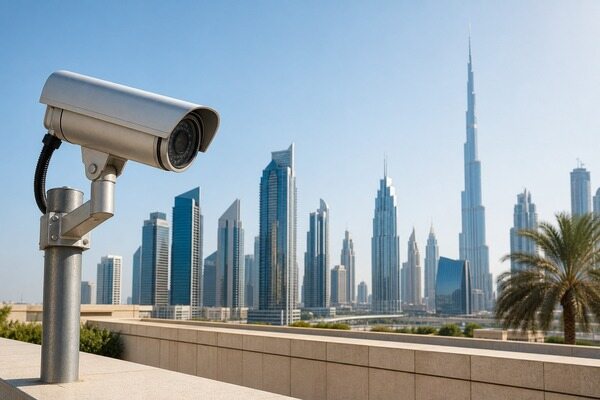
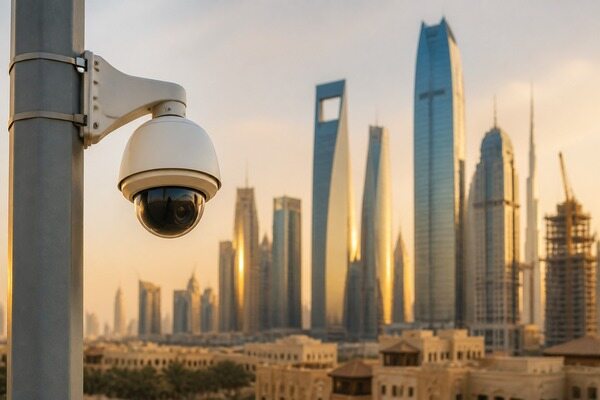
The Middle East now represents the fastest-growing destination for China security camera export 2026 shipments, with year-on-year import volumes from China rising approximately 180% since 2022. This is not a temporary spike — it is a structural rerouting of global surveillance supply chains driven by three converging forces.
First, infrastructure investment at sovereign scale. Saudi Arabia's Vision 2030 alone has allocated over $500 billion to new urban developments, including NEOM, the Red Sea Project, and Qiddiya — each of which requires comprehensive surveillance backbones. The UAE's smart-city programs in Dubai and Abu Dhabi are similarly driving demand for high-resolution, AI-enabled IP cameras. Second, heightened regional security requirements around critical infrastructure, transport hubs, and border control have elevated surveillance from an operational expense to a national-priority capital expenditure. Third, trade realignment — Middle Eastern governments and private distributors have actively diversified their technology supply chains, and Chinese manufacturers have moved aggressively to fill the gap with localized product lines.

The region's security camera market is projected to grow at a 14.7% CAGR, from $4.57 billion in 2025 to $6.06 billion by 2030 (Source: Mordor Intelligence, 2025). Annual new installations in the Middle East are forecast to reach 140 million units in 2026 (Source: Sky Market Insights).
"Middle Eastern buyers are no longer treating surveillance as a simple hardware category — they are demanding integrated solutions with region-specific engineering, from high-temperature thermal management to Arabic-language analytics interfaces. The suppliers who invest in that localization now will capture multi-year contracts that historically went to European and American brands," noted a regional market analyst at Mordor Intelligence.
For procurement managers, this means understanding what Middle Eastern buyers actually prioritize. Temperature tolerance is non-negotiable: cameras deployed in GCC countries routinely face ambient temperatures exceeding 50°C (122°F), requiring housings rated for 60–70°C sustained operation. IP67 or IP68 ingress protection is the minimum standard for outdoor installations exposed to sand and dust. Arabic-language OSD and mobile-app interfaces are becoming a de facto requirement for government and enterprise tenders. And SASO (Saudi Standards, Metrology and Quality Organization) certification through the SABER platform is mandatory for any shipment entering Saudi Arabia, the region's largest single market.
Phyvision, a specialized security camera supplier Middle East distributors have relied on for over a decade, now serves clients in 50+ countries with product lines purpose-built for high-temperature environments. Its Middle East-specific camera series features wide-operating-temperature-range components, enhanced dust sealing, and localized firmware — capabilities that generic OEM cameras often lack.

Key Certifications Chinese Cameras Need for Middle East Export
Certification is not an optional checkbox for Middle East procurement — it is a hard gateway. Customs clearance in Saudi Arabia, the UAE, and Kuwait requires specific compliance documentation, and distributors who attempt to import uncertified hardware routinely face shipment holds, fines, or outright rejection at port.
The baseline certification stack for any Chinese security camera targeting Middle Eastern distribution is CE (EU conformity), FCC (electromagnetic compatibility), and RoHS (hazardous substance restriction). While CE and FCC are not legally mandated by Gulf Cooperation Council (GCC) regulations, they function as de facto trust signals — most Middle Eastern importers and government tender documents require at least CE marking as evidence of basic quality assurance.
SASO certification through the SABER online platform is legally required for all electronic products entering Saudi Arabia. The process involves product testing against Saudi national standards and registration with a SASO-recognized conformity assessment body. Lead times for SASO certification typically range from 4 to 8 weeks, and the cost varies by product category and testing scope.
Certification | Applicable Markets | Difficulty | Phyvision Status |
CE | Europe + Middle East | Medium | ✓ Obtained |
FCC | North America | High | ✓ Obtained |
RoHS | Global | Low | ✓ Obtained |
NDAA Compliant | US Government Procurement | High | Pending |
SASO | Saudi Arabia | Medium | Pending |
Phyvision holds full CE, FCC, and RoHS certification across its product portfolio. NDAA compliance status is being evaluated for select product lines as part of a phased North American market strategy. SASO certification is in progress for Saudi-bound SKUs; buyers with urgent Saudi requirements should contact the Phyvision sales engineering team for the latest status and alternative compliant product recommendations.

Practical Buying Guide: Sourcing Security Cameras from China for the Middle East
The single most important procurement principle for Middle East-bound security camera wholesale China Middle East sourcing is this: validate certifications before placing a purchase order, not after. A factory's claim of CE compliance is meaningless without a verifiable certificate number that you can cross-reference on the European Commission's NANDO database (ec.europa.eu). Budget two to four weeks for certification verification as part of your supplier due diligence cycle.
Here are seven actionable steps for sourcing security cameras from China for the Middle East:
1. Request CE certificate numbers upfront and verify them at ec.europa.eu/growth/tools-databases/nando/. A legitimate manufacturer will provide this without hesitation. If a supplier deflects or offers only a "test report" without a registered certificate number, treat it as a red flag.
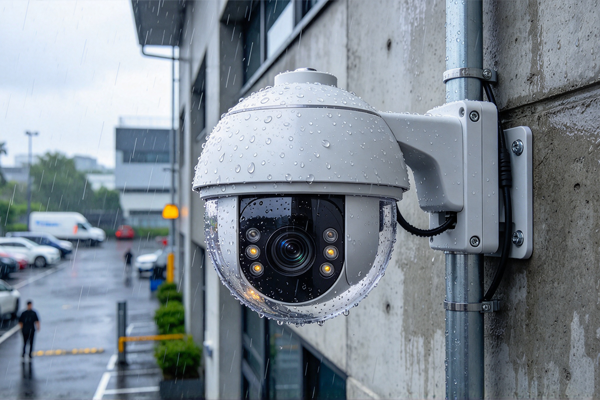
2. Specify IP67 or IP68 rating in your purchase contract with a defined testing protocol. Outdoor cameras in the Gulf region face sand ingress that IP66-rated housings cannot reliably block. Include a clause that permits third-party IP testing on pre-shipment samples.
3. Demand Arabic-language UI support in the technical specification sheet, not as a post-delivery firmware update. Major Middle Eastern government tenders now explicitly require Arabic OSD menus in the evaluation criteria, and distributors who retrofit this capability after import face weeks of delay.
4. Confirm operating temperature range in writing. A camera rated for -10°C to 50°C is insufficient for outdoor deployment in Riyadh or Dubai during summer months. Specify 60°C sustained operation as the minimum acceptable upper bound, and request the supplier's thermal test report.
5. Negotiate SASO compliance and SABER registration as a shared responsibility. Best practice is to agree in the contract that the supplier handles product testing and certificate application while the buyer handles SABER platform registration using the supplier's issued certificates.
6. Audit the supplier's export track record to your target country. A factory that has shipped to Western Europe but never to the Middle East may be unfamiliar with SASO documentation requirements, regional logistics partners, and customs clearance workflows. Request references from existing Middle Eastern clients.
7. Evaluate solar-powered 4G camera options for remote deployment. Off-grid surveillance is a fast-growing segment in the Middle East, particularly for oil and gas perimeter monitoring and agricultural security. Solar-powered 4G cameras eliminate trenching and cabling costs that can exceed the camera hardware cost by a factor of 3–5x in remote sites.
Phyvision's OEM/ODM program is designed for regional distributors and brand owners targeting the Middle East: MOQ starts at 100 units, standard lead times range from 7 to 30 days depending on customization depth, and free evaluation samples are available for qualified buyers. The engineering team supports custom housing colors, logo branding, firmware localization (including Arabic), and packaging design — all managed through a single point of contact from order to shipment.
FAQs
Q1: Which countries in the Middle East import the most security cameras from China?
Saudi Arabia and the UAE together account for over 55% of Chinese security camera imports into the Middle East by value, driven by large-scale smart-city projects and infrastructure expansion. Iraq, Kuwait, and Qatar are the next-tier markets, with combined import volumes growing at 20–25% year-on-year as post-conflict reconstruction and urban development programs accelerate.
Q2: What certifications does a Chinese security camera need for Middle East distribution?
At minimum, CE marking and RoHS compliance are expected by most Middle Eastern importers. For Saudi Arabia — the region's largest market — SASO certification through the SABER platform is legally mandatory for all electronic products. FCC certification, while not legally required, strengthens credibility in enterprise and government tender evaluations.
Q3: How has the NDAA ban on Hikvision and Dahua affected Chinese camera exports to the US?
The NDAA Section 889 ban has effectively closed the US federal procurement market to Hikvision and Dahua branded products, redirecting an estimated $1.5–2.0 billion in annual contract value toward NDAA-compliant alternatives. However, the broader US commercial market remains accessible, and many Chinese manufacturers are developing NDAA-compliant product lines with non-restricted chipset supply chains.
Q4: What is the average lead time and MOQ for bulk security camera orders from China?
Industry-standard MOQ for OEM orders typically ranges from 100 to 500 units, depending on customization requirements. For Phyvision specifically, MOQ starts at 100 units for branded OEM orders, with lead times of 7 days for standard products and 15–30 days for customized configurations. Container-level orders (1,000+ units) generally ship within 25–35 days including production and sea freight booking.
Q5: Are solar-powered 4G security cameras gaining market share in the Middle East?
Yes. Solar-powered 4G cameras now represent an estimated 12–15% of new outdoor surveillance deployments in the GCC region, up from below 5% in 2022. The economics are compelling for remote sites — eliminating trenching and grid-power connection costs can reduce total deployment cost by 60–70% compared to wired alternatives, making them increasingly popular for perimeter security, agricultural monitoring, and oil & gas applications.