How to Choose a Reliable Security System Supplier for UAE Projects
Choosing a security system supplier for UAE projects requires more than comparing camera prices. This guide explains how to evaluate applicable regulatory approvals, camera specifications, manufacturing quality, batch consistency, warranty coverage, logistics, and technical support before selecting a CCTV supplier. Use the practical checklist to identify potential risks and choose a supplier that matches your project's technical and operational requirements.

Choosing a reliable security system supplier in the UAE requires more than comparing camera prices and product specifications. Security projects may involve local approval procedures, specific installation requirements, demanding environmental conditions, and long-term maintenance responsibilities. Selecting the wrong supplier can lead to approval delays, equipment replacement, additional costs, and project disruption.
For security distributors, system integrators, contractors, and procurement managers, a structured supplier evaluation process helps reduce these risks before a purchase order is issued.
This guide explains how to evaluate a CCTV supplier for UAE projects, covering regulatory requirements, camera specifications, manufacturing quality, cybersecurity, warranty coverage, logistics, and after-sales support.
Key Takeaways
Verify applicable approvals: Identify the regulatory authority and project requirements before selecting cameras, recorders, and other security equipment. For projects in Dubai, consult the Security Industry Regulatory Agency (SIRA) and its applicable requirements.
Evaluate the complete solution: Check product specifications, compatibility, recording capacity, network security, and installation requirements rather than evaluating cameras in isolation.
Assess manufacturing quality: Request relevant quality certifications, inspection records, product test reports, and evidence of consistent production.
Confirm environmental suitability: Ensure that outdoor cameras are rated for the expected temperature, humidity, dust, UV exposure, and corrosion conditions.
Review long-term support: Clarify warranty coverage, replacement procedures, spare-parts availability, firmware updates, and technical support responsibilities.
Compare total project cost: Consider installation, compliance, maintenance, downtime, and replacement costs in addition to the initial equipment price.
1. Understand the Regulatory Requirements for Your UAE Project
Before evaluating suppliers, identify the location, facility type, and applicable approval requirements for your project. Security system requirements can vary by emirate, building category, project specifications, and the responsible authority.
Dubai: Check Applicable SIRA Requirements
The Security Industry Regulatory Agency (SIRA) regulates relevant security activities and equipment in Dubai. Its requirements are an important consideration when procuring CCTV cameras, recording equipment, and other security devices for projects within its jurisdiction.
Before placing an order, confirm:
Whether the proposed equipment requires SIRA approval or registration for the intended application.
Whether the exact product model is covered by the relevant approval documentation.
Whether the proposed installer and system integrator hold the required licenses.
Whether the security system design, installation, and recording arrangements satisfy the applicable project requirements.
Whether the supplier can provide the technical documents and samples needed for the approval process.
Do not rely solely on a supplier's statement that a product is "SIRA compliant." Request the relevant documentation and verify its scope and validity through the appropriate official channel.
Official reference: SIRA — Security Equipment and Devices Certification.
Abu Dhabi and Other Emirates: Confirm Local Requirements
Requirements applicable in Dubai should not automatically be assumed to apply in Abu Dhabi, Sharjah, Ajman, Ras Al Khaimah, Fujairah, or Umm Al Quwain.
For projects outside Dubai, confirm the responsible authority, the applicable approval process, and any additional requirements before finalizing the equipment specification. Projects involving critical infrastructure, public facilities, or government entities may also have project-specific security and documentation requirements.
Check Recording and Storage Requirements
Video retention requirements depend on the facility category and applicable regulations. For example, certain SIRA requirements specify a minimum retention period of 31 days.
However, the requirement for a particular project should be confirmed against the relevant current document rather than assumed to be identical across all facilities and emirates.
When evaluating a CCTV solution, ask the supplier to provide a storage calculation based on:
The number of cameras and recording channels.
Resolution and frame rate.
Video compression settings and expected bitrate.
Continuous or event-based recording schedules.
Required retention period.
Redundancy and available storage capacity.
A documented calculation helps determine whether the proposed NVR or video management system can meet the project's recording requirements.
2. Evaluate Camera Specifications for UAE Conditions
The UAE's climate can present challenges for outdoor surveillance equipment. High ambient temperatures, direct sunlight, airborne dust, humidity, and coastal salt exposure should all be considered during product selection.
A suitable camera must match the actual installation environment rather than simply meet a generic specification.
Operating Temperature
Review the manufacturer's rated operating temperature and determine whether it covers the expected conditions at the installation site.
For outdoor cameras exposed to direct sunlight, consider the effects of solar heating on the camera housing and internal components. Depending on the application, thermal management, suitable housing design, and installation location may also influence long-term reliability.
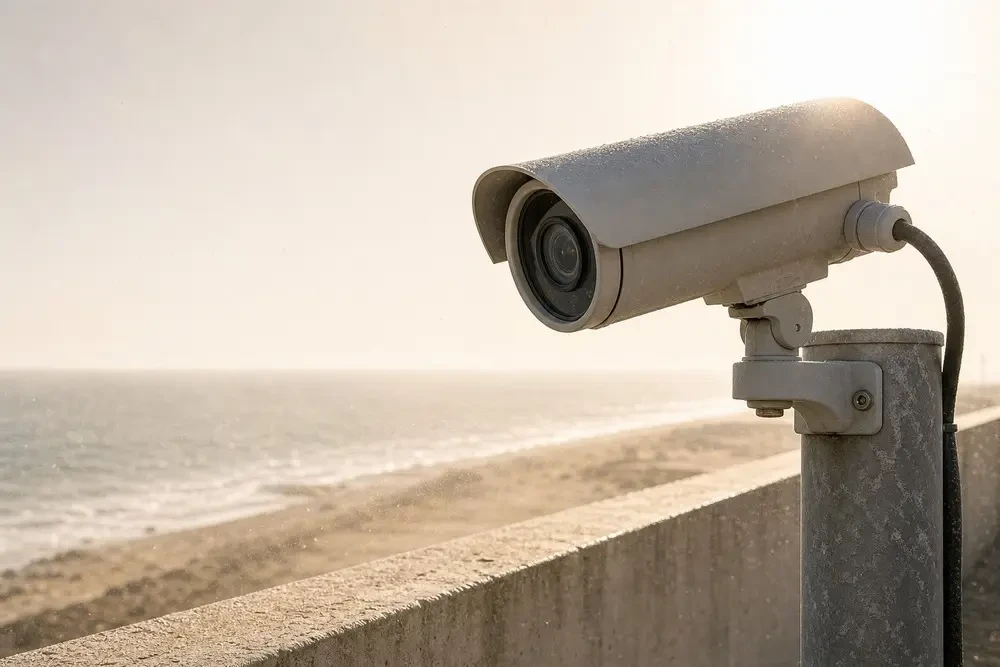
Ask the supplier for the official product datasheet and any available environmental test reports. Do not assume that every camera with a nominally high temperature rating will perform equally well under direct solar exposure.
Dust, Water, and Corrosion Protection
Dust, sand, rain, humidity, and coastal conditions can affect camera housings, seals, connectors, and mounting accessories.
When selecting outdoor equipment, check:
The IP rating specified by the manufacturer.
Whether the rating is appropriate for the installation environment.
Resistance to corrosion where salt exposure is expected.
Cable entry and connector sealing.
The suitability of mounting brackets and fasteners.
Any additional enclosure or installation requirements in the project specification.
Higher ingress-protection ratings or additional corrosion protection may be appropriate for some locations. The final specification should be based on the environmental exposure, applicable project requirements, and documented product capabilities.
Image Quality and Low-Light Performance
A camera's resolution alone does not determine whether it can provide useful evidence. Lens selection, sensor performance, lighting conditions, dynamic range, and installation geometry also affect image quality.
For each proposed camera, review:
Resolution and frame rate.
Wide dynamic range performance in challenging lighting.
Low-light performance and minimum illumination specifications.
Infrared illumination range, where applicable.
Lens focal length and field of view.
Image performance at the required identification or detection distance.
For example, a camera intended to monitor a wide entrance may require a different lens and image-performance profile from one intended to capture details at a distant perimeter.
Request sample footage or test results under conditions representative of the intended application whenever possible.
3. Assess Cybersecurity and System Compatibility
A reliable CCTV solution must protect the network as well as deliver usable video. Cameras, NVRs, VMS platforms, network equipment, and remote-access services should be evaluated as part of the complete system.
Ask the supplier to explain its cybersecurity capabilities and configuration requirements.
Network Security
Review whether the equipment supports appropriate security measures, including:
Unique credentials and secure account management.
Role-based access controls.
Secure communication protocols and encryption options.
Firmware updates and vulnerability remediation.
Disabling unnecessary services and interfaces.
Network segmentation where required by the project.
Secure remote access and documented configuration procedures.
Specific requirements should be matched to the project's security policy and applicable regulations. Do not assume that a particular encryption algorithm or network architecture is mandatory for every UAE installation without checking the relevant requirement.
Firmware Maintenance
A camera's security does not end when it leaves the factory. Vulnerabilities may be discovered during the product's service life, making a clear firmware-maintenance policy important.
Ask the supplier:
How are security vulnerabilities reported and assessed?
How are firmware updates distributed?
Are update procedures documented and tested?
What is the expected support period for the product?
How are customers informed about product end-of-life and security updates?
A supplier that can explain its maintenance process and provide clear technical documentation is better positioned to support a long-term deployment.
Camera, NVR, and VMS Compatibility
Confirm that the proposed cameras, recorders, and management software work together as intended.
Check supported protocols, recording functions, event integration, remote monitoring, playback, export formats, and firmware compatibility. If the project requires integration with an existing platform, request a compatibility statement or conduct a proof-of-concept test before mass deployment.
4. Evaluate the Supplier's Manufacturing and Quality Control
A supplier's ability to deliver a sample does not necessarily demonstrate that it can maintain consistent quality across repeated production batches.
For projects involving multiple sites or large camera quantities, manufacturing capability and quality control should be part of the procurement evaluation.
Factory and Quality Management
Request relevant documentation, which may include:
Current quality management system certificates.
Manufacturing and assembly process descriptions.
Incoming material inspection records.
In-process quality inspection procedures.
Final inspection and functional test records.
Environmental and reliability test reports, where applicable.
Corrective-action procedures for non-conforming products.

If an on-site factory audit is not practical, consider a remote assessment or an independent third-party audit appropriate to the project's risk level.
A certificate alone does not establish the quality of every product. Check the scope, validity, issuing body, and relevance of each certificate to the supplier and manufacturing facility being evaluated.
Batch Consistency
Batch consistency is particularly important when cameras are installed across multiple locations or delivered in stages.
Ask the supplier how it controls variation in image performance, focus, color reproduction, firmware versions, and other relevant characteristics.
Useful evidence may include:
Batch inspection reports.
Defined acceptance criteria.
Functional test records.
Traceability of production batches.
Procedures for handling failed products.
Corrective and preventive action records.
For large deployments, buyers can establish a sampling and acceptance plan before production begins. Acceptance criteria should reflect the product specification and project risk rather than an arbitrary universal percentage.
Sample Evaluation Before Mass Production
Before approving a large order, evaluate representative samples under realistic operating conditions.
Depending on the application, testing may cover image quality, low-light performance, recording stability, network compatibility, environmental suitability, and installation procedures.
Document the approved model, firmware version, accessories, and test results. These records provide a baseline for inspecting later production batches and managing changes.
5. Review Warranty, After-Sales Service, and Spare Parts
A supplier relationship should cover the product's operational life, not just the initial delivery.
Before signing a contract, establish clear responsibilities for technical support, replacement equipment, firmware maintenance, and warranty claims.
Warranty Terms
The warranty agreement should clearly define:
Warranty duration and its starting date.
Covered defects and exclusions.
Procedures for reporting failures.
Required diagnostic information.
Repair or replacement arrangements.
Responsibility for shipping and related costs.
Expected response and resolution times.
Do not assume that a particular warranty period is mandatory for every UAE project. Set the requirement according to the contract, procurement policy, product application, and operational risk.
Local Support and Replacement Procedures
For projects where downtime affects safety, business continuity, or contractual obligations, evaluate how quickly the supplier can diagnose issues and provide replacement equipment.
Ask whether support is provided directly or through an authorized local partner. Confirm the partner's responsibilities, available technical expertise, spare-parts arrangements, and escalation process.
If replacement stock is required, agree on the quantity, storage location, replenishment procedure, and ownership of the inventory.
Product Lifecycle and Firmware Support
Long-term projects may require additional cameras, replacement units, compatible accessories, or firmware updates several years after installation.
Ask the supplier to explain its product lifecycle policy, spare-parts availability, end-of-life notifications, and support arrangements for existing installations.
These details are especially important for integrators responsible for maintaining a consistent system across multiple sites.
6. Evaluate Logistics and Delivery Reliability
Delivery performance can influence installation schedules, commissioning, and project handover.
A supplier should provide a realistic delivery plan based on production capacity, product availability, shipping method, destination, and applicable import procedures.
Confirm Delivery Commitments
Request a written schedule that identifies:
Production lead time.
Sample approval and pre-production milestones.
Planned shipment date.
Shipping method and estimated transit time.
Required export and import documentation.
Responsibilities for customs clearance.
Procedures for handling delays or damaged goods.
Transit times should be treated as estimates rather than guarantees unless supported by a contractual commitment.
Check Documentation
Depending on the shipment and applicable regulations, documents may include a commercial invoice, packing list, certificate of origin, product datasheets, and relevant equipment approval documents.
Confirm the exact documentation required with the importer, customs broker, and relevant authorities before dispatch.
For projects requiring approved equipment, ensure that the supplied models and accompanying documents match the approved specification.
7. Compare Total Cost of Ownership, Not Just Camera Prices
A low initial quotation does not always represent the lowest overall project cost.
When comparing suppliers, consider the total cost of purchasing, deploying, operating, and maintaining the system over its expected service life.
Relevant cost factors include:
Equipment and accessories.
Integration and installation.
Required testing and approval procedures.
Freight, insurance, and import-related costs.
Storage and network infrastructure.
Training and commissioning.
Warranty service and replacement shipping.
Spare parts and ongoing maintenance.
Potential costs arising from incompatibility or premature failure.
Ask each shortlisted supplier to quote against the same specification and commercial assumptions. This makes it easier to distinguish genuine price differences from differences in product scope, service coverage, or contractual responsibility.
A structured comparison helps procurement teams balance purchase price, performance, reliability, and long-term support.
8. Supplier Due Diligence Checklist
Use the following checklist before approving a CCTV supplier for a UAE project.
Regulatory documentation
Confirm which approvals apply to the project.
Request documentation for the exact equipment models.
Verify the scope and validity of relevant approvals.
Confirm installer and integrator licensing where required.
UAE project experience
Request relevant project references.
Check whether previous projects involved similar facilities and technical requirements.
Ask how approval, commissioning, and after-sales issues were handled.
Manufacturing capability
Review manufacturing processes and quality management documentation.
Request relevant factory audit or inspection records.
Confirm whether the supplier can support the required quantity and delivery schedule.
Quality assurance
Review functional test procedures and inspection records.
Request applicable environmental and reliability test results.
Confirm batch traceability and non-conformance handling procedures.
Product suitability
Verify operating temperature and environmental ratings.
Assess image quality, lens selection, and low-light performance.
Confirm camera, NVR, and VMS compatibility.
Cybersecurity and maintenance
Review account security, network configuration, and firmware update procedures.
Confirm the product support period and vulnerability-response process.
Verify that the proposed configuration meets the project's requirements.
Warranty and technical support
Confirm warranty coverage and replacement procedures.
Identify the responsible service provider.
Agree on response times, escalation procedures, and spare-parts arrangements.
Logistics and commercial terms
Obtain a realistic delivery schedule.
Confirm the required shipping and import documentation.
Compare quotations using consistent specifications and total-cost assumptions.
If a supplier cannot provide evidence for an important requirement, record the gap and resolve it before proceeding. Whether the gap is acceptable depends on its impact on regulatory compliance, operational risk, and project obligations.
9. Red Flags to Watch for When Choosing a CCTV Supplier
Certain warning signs justify additional due diligence before a purchase decision.
Unsupported Certification Claims
Be cautious if a supplier claims that its equipment is approved but cannot provide relevant documentation for the exact model. Ask for the certificate or approval reference and verify it through the appropriate authority.
An application receipt, a general test report, and a valid equipment approval are not necessarily interchangeable.
Vague Quality Claims
Statements such as "high quality" or "stable performance" should be supported by relevant evidence.
Request test records, acceptance criteria, traceability information, and examples of how the supplier handles quality issues.
Unclear Warranty Responsibilities
If the quotation does not explain who handles troubleshooting, replacement shipping, repair, and technical escalation, the buyer may face unexpected costs or delays after delivery.
Clarify these responsibilities in writing before placing the order.
Incomplete Technical Documentation
Missing datasheets, unclear firmware versions, inconsistent model numbers, and undocumented compatibility limitations can create problems during installation and maintenance.
Require the supplier to provide a complete and consistent technical document package for the proposed configuration.
Unusually Low Quotes Without a Clear Scope
A significantly lower quotation deserves closer examination, but price alone does not prove that a supplier is unreliable.
Compare component specifications, included accessories, approval status, warranty coverage, delivery terms, and support commitments. Ensure that every supplier is quoting against the same requirements.
10. Why Manufacturing Capability Matters for Security System Integrators
For security system integrators, distributors, and equipment brands, supplier evaluation should include both the finished product and the manufacturing process behind it.
Consistent production, documented inspection procedures, product traceability, and responsive engineering support can help reduce quality risks across repeated orders.
Depending on the business model, buyers may also consider OEM or ODM manufacturing when developing a branded camera product or a project-specific security solution.
When evaluating a manufacturing partner, discuss the intended application, required product configuration, image-performance targets, environmental conditions, interface requirements, testing procedures, and expected production volume.
The supplier should be able to explain which requirements can be met by an existing product and which would require engineering changes, additional validation, or a separate approval process.
For Phyvision, these are also important considerations when discussing security camera solutions with distributors and system integrators. Product selection should begin with the customer's application and technical requirements, followed by a review of product compatibility, manufacturing quality, and long-term support needs.
Frequently Asked Questions
1. How do I choose a reliable security system supplier in the UAE?
Start by identifying the applicable project requirements and verifying relevant equipment approvals. Then evaluate product specifications, manufacturing quality, technical documentation, warranty terms, delivery reliability, and after-sales support. Compare suppliers against the same written specification rather than price alone.
2. Is SIRA approval required for every CCTV camera used in the UAE?
Requirements depend on the project location, equipment type, facility category, and applicable regulations. SIRA is relevant to security equipment and projects within its jurisdiction in Dubai. Confirm the approval requirements for the specific equipment and project with the responsible authority before procurement.
3. How long must CCTV footage be retained in the UAE?
The required retention period depends on the applicable rules and project specifications. Certain SIRA requirements specify at least 31 days, but this should not be treated as a universal period for every facility or emirate. Confirm the current requirement for the intended application before calculating storage capacity.
4. What specifications should I check when selecting outdoor security cameras for the UAE?
Review the rated operating temperature, ingress protection, corrosion resistance, image quality, low-light performance, lens and field of view, and power requirements. The final selection should reflect the actual installation environment and project specification.
5. What documents should I request from a CCTV supplier?
Depending on the project, request product datasheets, applicable approval documents, quality management certificates, test reports, inspection records, firmware information, warranty terms, installation guidance, and relevant project references. The required document package should be agreed upon before ordering.
6. Why should I evaluate a CCTV supplier's manufacturing capability?
Manufacturing capability affects product consistency, traceability, delivery reliability, and the supplier's ability to address quality issues. Reviewing production controls and inspection records helps buyers assess whether a supplier can support repeated orders and long-term projects.
7. How can I compare CCTV suppliers beyond price?
Compare the complete scope of supply, including equipment, accessories, compatibility, approval documentation, shipping, warranty, spare parts, technical support, and maintenance. A consistent comparison framework makes it easier to identify the actual cost and risk differences between quotations.
Conclusion
Choosing a reliable security system supplier for UAE projects requires a structured assessment of regulatory requirements, product suitability, manufacturing quality, cybersecurity, logistics, and long-term support.
Before placing an order, verify the requirements that apply to the project, request supporting documentation, evaluate representative samples where appropriate, and clarify commercial and warranty responsibilities in writing.
A supplier that can demonstrate its capabilities with clear evidence is easier to evaluate and provides a stronger foundation for a successful long-term partnership.
If you are evaluating security camera solutions for your next project, start by defining the application, technical requirements, and expected deployment scale. These details will help you identify the equipment and manufacturing capabilities that matter most.
About Phyvision
Phyvision provides security camera and surveillance-related solutions for professional customers, including distributors and system integrators. Contact the Phyvision team to discuss your project requirements, product configurations, and potential OEM or ODM cooperation.
Regulatory note: This article is intended as a supplier-evaluation guide, not legal or regulatory advice. Requirements may change and should be confirmed with the relevant authority and project stakeholders before procurement.