Bank Security Camera System: Complete Surveillance Solution
A bank robbery occurs every 8 minutes — but the real loss is non-compliant footage. This guide covers bank-grade camera selection, retention storage, ATM security, and sourcing at 35–50% cost advantage.
Key Takeaways
Three compliance layers gate every bank system: national regulations, insurance underwriters, and internal risk policies — failing one voids coverage.
Zero-blind-spot doctrine: every counter, ATM, vault, and cash zone needs a dedicated camera.
China sourcing advantage: 4K/120dB WDR/AI analytics at 35–50% lower cost than traditional vendors.
Plan storage at procurement: 90–180 day retention needs 12–24 TB per 32-camera branch.
Spec ATM security upfront: tamper-detection firmware + alarm integration — retrofitting costs 3–4× more.
A bank robbery occurs somewhere in the world approximately every 8 minutes. But the financial loss that concerns security directors most is not the robbery itself — it is the liability exposure when surveillance footage is incomplete, unclear, or non-compliant with regulatory retention standards. A single incident reviewed by insurance adjusters or banking regulators where the camera system failed to capture usable evidence can result in claim denial, regulatory fines, and reputational damage that far exceeds the cost of the entire surveillance system.
This guide provides procurement managers, system integrators, and OEM brand owners with a comprehensive framework for designing, sourcing, and deploying bank-grade surveillance systems. It covers the regulatory landscape, camera selection criteria by zone, storage and retention architecture, and practical sourcing strategies from Chinese manufacturers who now dominate the mid-to-high-tier banking surveillance export market.
Security Requirements and Regulatory Standards for Financial Institutions
Bank surveillance is governed by a hierarchy of requirements that varies by jurisdiction but follows consistent principles worldwide. Understanding this hierarchy before specifying any hardware prevents the most expensive mistake in bank security design: deploying a system that passes technical commissioning but fails regulatory audit.
National banking regulations form the top tier. In the United States, the Bank Protection Act (12 CFR Part 21) mandates that each banking office designate a security officer, establish written security procedures, and maintain surveillance equipment appropriate to the office's size, location, and risk profile. In the European Union, the revised Payment Services Directive (PSD2) and national implementations set minimum physical security standards for payment institutions. In ASEAN markets, central bank regulations in Indonesia (Bank Indonesia Regulation 18/8/PBI/2016), Thailand (Bank of Thailand Notification 13/2559), and Vietnam (SBV Circular 47/2022) define camera coverage requirements, resolution minimums, and retention periods. Procurement managers must obtain the current versions of these regulations for each target country before finalizing camera specifications — summaries and second-hand interpretations are not acceptable substitutes.
Insurance underwriter requirements often exceed regulatory minimums. Major financial institution insurers such as Lloyd's syndicates, AXA XL, and Allianz Global Corporate & Specialty maintain their own physical security standards as conditions of coverage. These typically mandate 90–180 day video retention (vs. 30–60 days in most national regulations), 4MP minimum resolution for transaction-zone cameras (vs. 2MP regulatory minimums in some jurisdictions), and redundant recording architecture (dual NVR or NVR + cloud backup). A system that meets national regulations but fails insurer standards will result in denied claims after an incident — a risk that renders the entire surveillance investment worthless.
Internal risk management policies add institution-specific requirements such as facial recognition at restricted access points, integration with access control systems, and real-time anomaly detection alerts routed to security operations centers. These policies typically require higher camera resolution and more sophisticated analytics than regulatory or insurance mandates, and they represent the layer where the gap between a minimum-compliant system and a genuinely effective system becomes visible.
Core Components of a Bank Security Camera System
A bank-grade financial institution security system is composed of five integrated subsystems, each of which must be specified, procured, and tested independently before system integration testing begins.
Camera Hardware. Bank surveillance cameras divide into four functional categories based on deployment zone. Counter cameras (2–4MP, fixed lens, 90°+ field of view) capture customer-facing transactions at teller windows and service desks. Lobby overview cameras (4–8MP, fisheye or multi-sensor panoramic) provide 180° or 360° coverage of customer areas with no blind spots between fixtures. Vault and cash-handling cameras (4MP+, anti-IR-reflection dome with privacy masking capability) monitor restricted zones where cash is counted, stored, and transported. ATM cameras (2MP pinhole or compact form factor, with tamper-detection firmware) provide covert or semi-covert coverage of ATM fascias and self-service terminals. Each category requires different mounting heights, lens specifications, and environmental tolerances.
Recording and Storage Architecture. Financial institutions require a minimum of two concurrent recording paths for transaction-zone cameras — typically a primary NVR and a secondary NVR or cloud backup. RAID 5 or RAID 6 storage arrays with surveillance-rated hard drives (WD Purple Pro or Seagate SkyHawk AI) are the minimum acceptable configuration. Storage must be calculated per-camera with a 20% margin above regulatory retention requirements. A 32-camera branch with 4MP cameras at 8 Mbps continuous recording generates approximately 2.76 TB per day; 90-day retention requires 248 TB of raw capacity, or approximately 310 TB with RAID 5 parity overhead.
Network Infrastructure. Bank surveillance operates on a physically and logically separate VLAN from the institution's business network. This segregation is required by PCI DSS (Payment Card Industry Data Security Standard) for any network segment that processes or stores payment data. Managed PoE switches with port-level bandwidth monitoring, SNMP trap alerting for link failures, and redundant power supplies are standard for all but the smallest branch deployments.
Video Management Software (VMS). The VMS must support role-based access control with audit trails, encrypted video export with digital watermarking, and integration APIs for the institution's access control and alarm systems. ONVIF Profile G (edge recording), Profile M (metadata), and Profile T (advanced streaming) support enables mixing camera brands as the system expands. For multi-branch deployments, the VMS should support centralized management with local recording to maintain video availability during WAN outages.
Physical Security Integration. Surveillance cameras are one component of a layered physical security architecture that also includes access control, intrusion detection, and alarm monitoring. Camera systems must integrate with these layers via dry contact relays (for alarm-triggered PTZ presets and recording boost), MODBUS or BACnet protocols (for building management system integration), and API connections (for real-time event correlation in the security operations center).
Zone | Camera Type | Resolution | Key Feature | Regulatory Reference |
Teller Counter | Fixed dome, 2.8mm lens | 4MP minimum | 120dB WDR for backlit windows | Bank Protection Act CFR 216.3 |
Customer Lobby | Fisheye or multi-sensor panoramic | 8MP | 360° coverage, no blind spots | National banking regulations |
Vault / Cash Room | Anti-IR-reflection dome | 4MP+ | Privacy masking, dual recording | Insurance underwriter standards |
ATM Fascia | Pinhole / compact wedge | 2MP | Tamper detection, encrypted edge storage | PCI DSS 3.2.1 |
Perimeter / Parking | Bullet with IR 50m | 4MP | IP67, IK10, LPR-ready | Site-specific risk assessment |
Indoor Bank Surveillance: Lobby, Counter, and Vault Design
Indoor surveillance in financial institutions follows the zero-blind-spot doctrine and must additionally address lighting conditions that are uniquely challenging in bank environments.
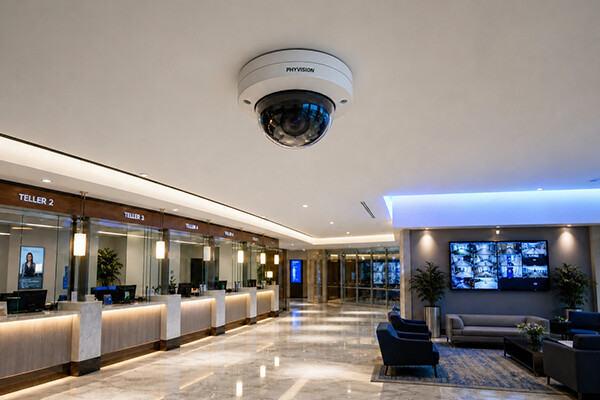
Teller counter coverage is the most legally sensitive surveillance zone in any financial facility. Every transaction position requires a dedicated camera mounted at 2.3–2.5 meters height, angled at 15–20° downward, with a field of view that captures the customer's face, the teller's hands, and the transaction counter surface in a single frame. The camera must achieve facial identification resolution — defined by the IEC 62676-4 standard as a minimum of 125 pixels per meter at the target distance, or approximately 250 pixels across a human face — under all lighting conditions including strong backlight from lobby windows. This requirement drives the specification of 4MP cameras with 120dB WDR as the minimum, not 2MP with 90dB WDR.

Lobby overview cameras must eliminate the coverage gaps that occur when customers move between individual counter cameras' fields of view. A single 12MP fisheye camera ceiling-mounted at the lobby center provides full 360° coverage and allows digital PTZ in post-event review. For larger lobbies exceeding 15 meters in any dimension, two or more fisheye cameras with overlapping coverage zones are required. The installation height formula for fisheye cameras: a ceiling height of 3 meters provides approximately 8 meters of usable facial identification radius; at 4 meters ceiling height, this drops to approximately 5.5 meters.
Vault and cash-handling zone coverage requires dual-camera redundancy. Each vault door, cash-counting station, and safe-deposit access area must be covered by two cameras at different angles — typically one overhead and one wall-mounted at eye level — to eliminate the possibility that a single person or object obstructs the view. Cameras in these zones must support privacy masking for areas where ATM PIN entry or other sensitive data may be visible, and all footage must be recorded on a physically separate NVR from lobby and counter feeds.
ATM and Self-Service Zone Security Architecture
The ATM remains the highest-risk surveillance zone in retail banking, accounting for approximately 45% of physical security incidents including card skimming, cash trapping, and customer assault. ATM security camera solutions require a dedicated design approach that accounts for the unique physical constraints and threat vectors of self-service terminals.
ATM fascia cameras must capture the user's face and upper body from a mounting position within or directly above the ATM housing. The camera form factor is constrained by the ATM bezel design — pinhole cameras (3.7mm lens, 2MP sensor) and compact wedge cameras with tamper-resistant housings are the two dominant form factors. Resolution must achieve facial identification quality at the 0.5–1.0 meter operating distance typical of ATM use. Integrated IR illumination (850nm wavelength, invisible to the user) ensures usable footage during nighttime and low-light indoor conditions.
Environment overview cameras covering the ATM vestibule, drive-through lane, or exterior ATM wall provide contextual footage that the fascia camera cannot capture — including multiple individuals approaching the ATM, vehicles in the drive-through, and suspicious activity in the surrounding area. These cameras must be mounted at 3.0–3.5 meters with a field of view that includes the ATM approach path, the user position, and at least 5 meters of surrounding area.

Tamper detection and alarm integration is mandatory for ATM cameras. The camera firmware must detect and alert on physical tampering, lens obstruction, scene change (camera repositioned), and video signal loss. These alerts must trigger both local recording boost (increased frame rate from 15 fps to 25–30 fps) and integration with the ATM's alarm panel via dry contact relay. For ATMs in high-risk locations, cameras with edge-storage SD card slots (256GB+) provide an additional layer of redundancy if the network connection to the NVR is severed during an incident.
Perimeter and Parking Lot Surveillance for Financial Facilities

Perimeter surveillance for financial institutions serves two distinct functions: deterrence of unauthorized access during operating hours, and forensic investigation capability for after-hours incidents. The technical requirements for these two functions are different and must be specified separately.
Operating-hours perimeter coverage prioritizes license plate capture at vehicle entry points and facial identification at pedestrian entry points. ANPR cameras with integrated IR illumination at entry and exit lanes must achieve a minimum 95% daytime and 90% nighttime plate recognition accuracy. These cameras require global shutter sensors to eliminate motion blur on moving vehicles, and the mounting angle must not exceed 30° from the vehicle's direction of travel — steeper angles reduce recognition accuracy by 15–20% even with specialized algorithms.
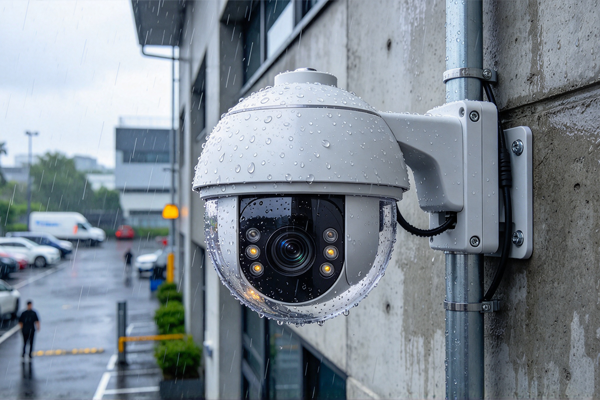
After-hours perimeter coverage prioritizes intrusion detection and evidence-quality recording in low-light conditions. PTZ cameras with 30x+ optical zoom, laser IR illumination (range 200m+), and auto-tracking firmware patrol preset routes and lock onto moving targets when triggered by perimeter intrusion detection system (PIDS) events. These cameras must be IP67-rated for outdoor exposure and IK10-rated for vandal resistance.
Parking lot surveillance requires a combination of overview cameras (multi-sensor panoramic for wide-area coverage) and detail cameras (PTZ for investigating specific incidents). The overview cameras must achieve at minimum 62.5 pixels per meter at the furthest parking space — the IEC 62676-4 detection standard — while detail cameras must achieve facial or plate recognition resolution at their maximum zoom range. Parking lot lighting must be evaluated during the site survey: cameras with Starlight or DarkFighter low-light sensor technology (minimum illumination 0.002 lux or lower) are necessary for lots with inconsistent or aging lighting infrastructure.
Sourcing Bank-Grade Security Cameras from China
For distributors and system integrators supplying bank security system hardware to financial institutions in emerging and developing markets, Chinese manufacturers represent the primary source of cost-competitive, specification-compliant equipment. The supply chain advantage is structural — integrated camera manufacturing in Shenzhen, Hangzhou, and Xiamen produces bank-grade cameras at 35–50% below the cost of cameras from traditional banking equipment vendors — but the evaluation criteria for bank-grade hardware are more stringent than for commercial surveillance.
Regulatory compliance documentation must be provided before purchase order issuance, not after. Request the manufacturer's ISO 9001 (quality management) and ISO 27001 (information security management) certificates, plus product-specific certifications (CE, FCC, RoHS) with verifiable certificate numbers. For financial institution tenders, many buyers additionally require an ISO 22301 (business continuity management) certificate from the manufacturer and a written guarantee of parts availability for a minimum of 5 years after product end-of-life.
Image quality consistency across batches is critical for bank environments where all cameras in a zone must produce footage of equivalent evidentiary quality. Request a batch consistency test report that demonstrates less than 5% variance in resolution (measured in line pairs per millimeter), color reproduction (Delta E < 3), and signal-to-noise ratio across a random sample of 20 cameras from the most recent production run. Manufacturers who cannot provide this report are acceptable for commercial surveillance but not for bank-grade deployments.
Firmware security and update policy must be evaluated before procurement. Confirming that the manufacturer maintains a firmware vulnerability disclosure and patching process — typically security patches released within 30 days of CVE disclosure, with a documented update mechanism that does not require on-site technician visits — is mandatory for any camera that will operate on a financial institution's network. Cameras with hardcoded credentials, open Telnet ports, or known CVEs older than 90 days should be eliminated from consideration.
Phyvision's financial institution program serves distributors and system integrators with bank-grade camera hardware including 4MP WDR dome cameras for counter deployment, 12MP fisheye cameras for lobby coverage, compact ATM cameras with tamper-detection firmware, and 4MP Starlight PTZ cameras for perimeter surveillance. CE, FCC, and RoHS certifications are maintained across the product portfolio, with MOQ starting at 100 units, lead times of 10–25 days, and free evaluation samples for qualified buyers. Phyvision maintains ISO 9001 certification and provides batch consistency documentation as a standard part of the pre-shipment quality package.
Requirement | Regulatory Driver | Hardware Implication | Phyvision Capability |
90–180 day retention | Insurance underwriters | 248+ TB per 32-camera branch | Compatible with all major NVR platforms |
4MP minimum at counters | Most national banking regs | WDR 120dB+, facial ID resolution | ✓ 4MP WDR dome cameras |
Dual recording paths | PCI DSS / insurer standards | Dual NVR or NVR + cloud | NVR-agnostic, ONVIF Profile G |
Tamper detection at ATMs | PCI DSS 3.2.1 | Firmware-level detection + dry contact | ✓ ATM camera series |
Camera segregation from business network | PCI DSS | Dedicated VLAN, managed switches | ONVIF compliant, VLAN compatible |
ISO 27001 manufacturer cert | Enterprise bank RFPs | Supplier audit trail | In progress |
FAQs
Q1: What is the minimum camera resolution required for bank surveillance?
National banking regulations typically mandate 2MP as the minimum, but insurance underwriters and internal risk policies commonly require 4MP for transaction-zone cameras to achieve facial identification resolution (125+ pixels per meter at the counter distance). Lobby overview cameras for larger branches require 8MP fisheye or 12MP multi-sensor panoramic cameras to maintain usable resolution across the full field of view.
Q2: How long must bank surveillance footage be retained?
National regulations typically mandate 30–90 days, but major financial institution insurers (Lloyd's, AXA XL, Allianz) standardize on 90–180 days as a condition of coverage. A 32-camera branch recording 4MP at 8 Mbps 24/7 generates approximately 2.76 TB per day, requiring 248 TB for 90-day retention and 496 TB for 180-day retention with continuous recording.
Q3: Can Chinese-manufactured cameras meet Western bank security standards?
Yes, provided the manufacturer holds verifiable CE, FCC, and RoHS certifications and can provide batch consistency test reports and ISO 9001 quality management documentation. The key distinction is documentation rigor, not country of origin — a Chinese manufacturer with full certification documentation is bank-grade compliant; one without documentation is not, regardless of camera specifications.
Q4: Do ATM cameras require a separate recording system from branch cameras?
PCI DSS requires logical network segregation of payment-processing systems, which typically includes ATM cameras. While ATM cameras can record to the same VMS platform as branch cameras, they should operate on a dedicated VLAN and record to a storage pool that is access-controlled separately from general branch surveillance footage. Edge storage (on-camera SD card) provides a recommended additional layer of redundancy.
Q5: What is the typical budget for a complete bank branch surveillance system?
A 32-camera bank branch including counter domes, lobby fisheyes, vault cameras, ATM cameras, and perimeter cameras typically ranges from $18,000 to $45,000 for camera hardware depending on resolution and feature mix. NVR, storage, managed switches, and installation add $15,000–35,000. Chinese-manufactured cameras reduce the hardware component by 35–50% compared to cameras from traditional banking equipment vendors.